 Home
HomeWhat Are the IP Requirements for Bathroom Lighting Safety ?
 A-ONE LED Lighting
 May 16,2026

Selecting bathroom lighting is far more challenging than choosing fixtures for other spaces due to the environment’s unique demands. High humidity, water spray, and the risk of submersion require lighting components to meet strict IP standards to ensure safety and durability.
In the UK and Europe, compliance with standards like BS 7671 and IEC 60364-7-701 is essential. These regulations specify the minimum IP ratings for different bathroom zones, such as IP44 or higher, depending on the location and exposure. Understanding these requirements is crucial for wholesalers and contractors—not only to ensure legal compliance but also to reduce after-sales costs and protect brand reputation. At our China factory, A-ONE, we produce bathroom lighting that meets these strict IP standards. This guide explains the reason behind bathroom IP protection requirements, helping you make informed decisions during project bidding and product selection in Europe.
Defining Bathroom Zones 0, 1, and 2: The Logic of Spatial Safety
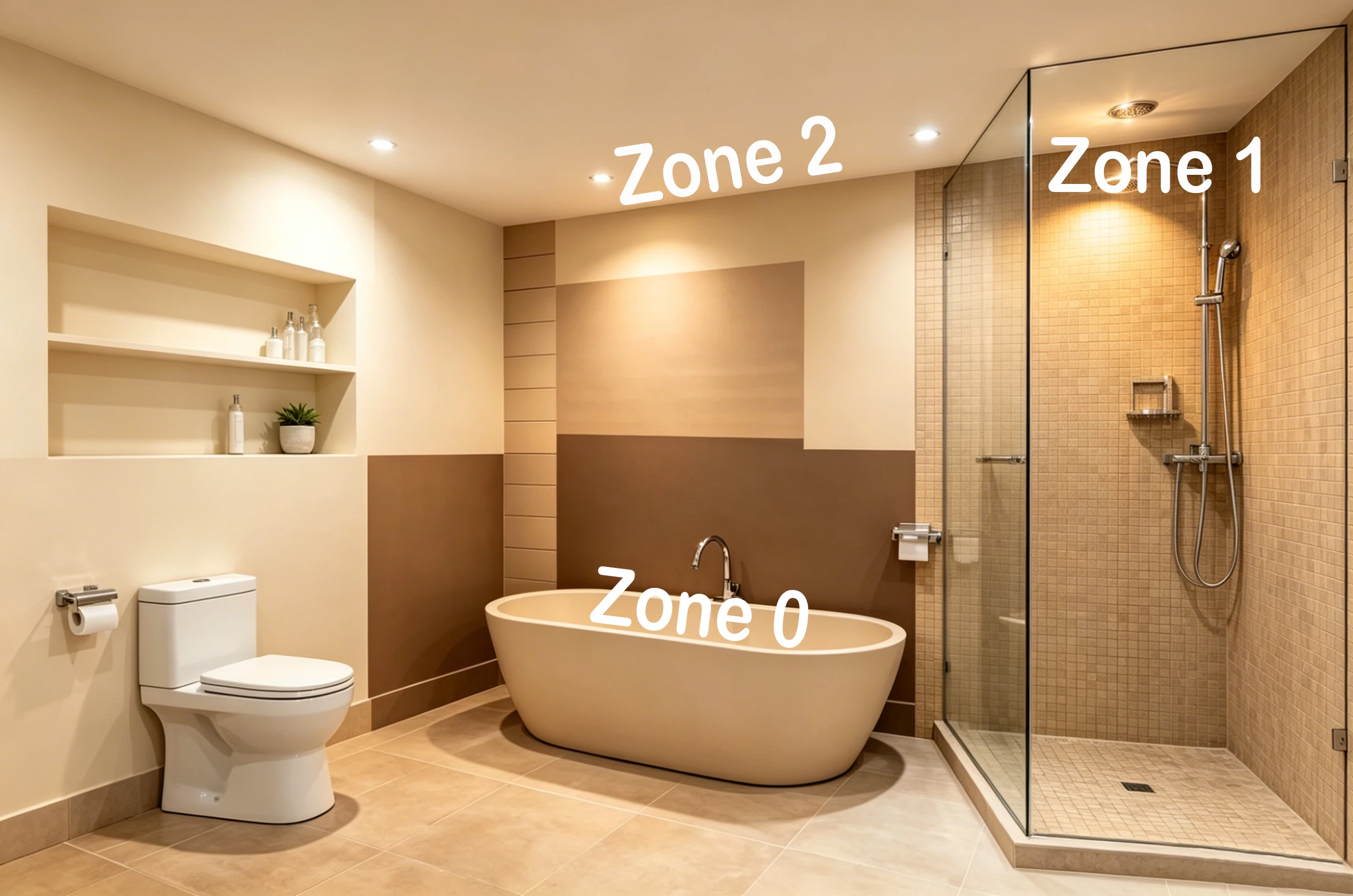
Before exploring specific technical parameters, we must establish a framework for understanding the bathroom space. In British and European electrical standards, a bathroom is not treated as a single uniform area. Instead, it is divided into "Zones" based on the level of risk regarding electric shock. This classification quantifies the likelihood of water coming into contact with electricity, which ultimately determines the required IP (Ingress Protection) rating.
Zone 0: The Interior High-Risk Area
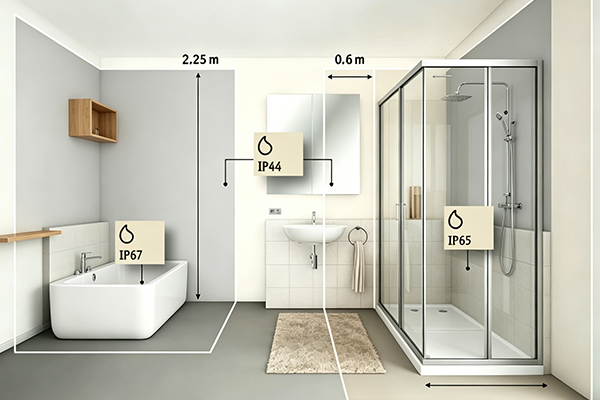
Zone 0 refers to the interior space of the bathtub or the shower tray. This is the area with the highest risk, as fixtures may be completely submerged in water. Lighting requirements here are exceptionally strict: they must use low-voltage power (typically 12V SELV) and carry a protection rating of at least IPX7. For most B2B procurement, unless dealing with luxury spa projects or specific landscape bathtubs, installing complex light sources in Zone 0 is generally avoided to minimize maintenance risks.
Zone 1: The Direct Spray Area
Zone 1 is defined as the area directly above the bathtub or shower tray, extending to a height of 2.25 meters from the floor. If you are designing a walk-in shower with a rain-style showerhead, every fixture beneath that showerhead falls within Zone 1. Because this area frequently endures direct water flow, fixtures must resist direct spray. While commercial standards often cite IPX4 as a minimum, A-ONE strongly recommends IP65 for fixtures positioned directly above showers to ensure complete protection against sustained water jets.
Zone 2: The Splash and Condensation Area
Zone 2 extends 0.6 meters beyond Zone 1 and includes the specific area around the washbasin. While this zone does not face the same high-pressure spray as Zone 1, airborne condensation and occasional splashes are silent killers of lighting longevity. All equipment in this area must reach at least an IPX4 rating.
Understanding these boundaries is vital for contractors to manage material costs effectively. Over-specifying where it isn't required creates unnecessary premiums, while under-specifying in risk zones can lead to severe legal consequences and safety failures.
Decoding IP44, IP65, and IP67: What Do These Ratings Mean
In the IEC 60529 standard defined by the International Electrotechnical Commission, an IP rating is not just a label—it is a rigorous experimental testing system used to measure a device's defense against solids and liquids.
The Structure of IP Ratings
An IP rating consists of two digits. The first digit represents protection against solid objects (scaled 0 to 6), and the second digit represents protection against liquids (scaled 0 to 9).
| Solid | Liquid |
| IP 0x - No protection | IP x0 - No protection |
| IP 1x - Protected against objects > 50mm | IP x1 - Protected against vertically falling water drops |
| IP 2x - Protected against objects > 12.5mm | IP x2 - Protected against water drops falling at a 15° tilt |
| IP 3x - Protected against objects > 2.5mm | IP x3 - Protected against spraying water (up to 60° from vertical) |
| IP 4x - Protected against objects > 1.0mm | IP x4 - Protected against splashing water (from any direction) |
| IP 5x - Dust-protected (limited ingress allowed without harmful deposits) | IP x5 - Protected against water jets (12.5L/min water flow) |
| IP 6x - Dust-tight (no ingress of dust) | IP x6 - Protected against powerful water jets (against heavy seas or strong jets) |
| IP x7 - Temporary immersion (protection against immersion up to 1m depth) | |
| IP x8 - Continuous immersion (depth and time specified by manufacturer) | |
| IP x9 - High-pressure/steam-jet cleaning (extreme industrial cleaning environment) |
Core Differences for Bathroom Applications
IP44, IP65, and IP67 are the most common ratings you will encounter. Moving from IP44 to IP65 requires a systematic reconstruction of the fixture's airtightness, while IP67 is an extreme solution for high-risk spots:
- IP44: Splash-proof.
- IP65: Jet-proof.
- IP67: Submersion-proof for short periods.
Practical Application: Where Each Rating Belongs
To help wholesalers and brand owners recommend solutions efficiently, we simplify the matching logic into three clear scenarios:
IP44 Lighting (The Universal Baseline)
This is the minimum compliant choice for Zone 2 and beyond. IP44 effectively blocks pervasive water vapor, preventing internal circuit corrosion. For budget-conscious residential projects, IP44 provides safety without inflating the overall project cost.
IP65 Lighting (The Shower Standard)
Recommended for Zone 1. With the rising popularity of walk-in showers in the European market, fixtures are closer to water sources than ever before. IP65 can withstand water jets from all directions, ensuring that internal reflectors remain free of mildew or fogging.
IP67 Lighting (The Landscape and Luxury Choice)
Designed specifically for Zone 0. In high-end hotel designs, in-ground lights or ambient lights along the rim of a bathtub are common. In these areas where water might pool, IP67 is the only compliant choice. These fixtures must also be highly resistant to corrosion from bathroom cleaning chemicals.
Cost vs. Performance: What Drives the Price Difference
High protection ratings involve complex material science and manufacturing costs.
- IP44 Fixtures: The cost is relatively balanced, with the premium usually found in the anti-oxidation treatment of the housing.
- IP65 Fixtures: Typically, these see a 15%–25% price increase over IP44. This reflects the inclusion of waterproof drivers, fully sealed structural designs, and rigorous factory pressure testing.
- IP67 Fixtures: Due to pressure-resistant structures and vacuum-sealed processes, the price is often double that of IP44.
FAQ: Addressing Common Client Concerns
1. Can IP65 fixtures be installed in IP44 zones?
Yes. Upward compatibility enhances system safety and allows for a unified look across a project, which simplifies inventory management for wholesalers.
2. Why did my IP44 fixture develop internal condensation after six months?
This is usually caused by poor thermal management. When a light is turned off, the internal temperature drops, creating negative pressure that sucks in humid air. Additionally, low-quality sealing rings that cannot withstand heat will eventually fail.
3. Are specific certifications required for the UK market?
Yes. In addition to the CE mark, fixtures entering the UK must meet UKCA requirements. Having IP test reports from an authoritative international lab is a powerful endorsement for B2B trade.
4. Is dimming performance affected by high IP ratings?
No. Protection ratings apply to the physical housing, while dimming is controlled by the driver. High-quality DALI or Triac dimmable drivers can be seamlessly integrated into high-IP systems.
5. What happens if I install an IP20 fixture in Zone 2?
While it may work initially, the humidity will eventually rust the metal and cause short circuits. In the European legal environment, this could lead to serious breach-of-contract liabilities and safety hazards for the contractor.
Professional Bathroom Lighting Solutions from A-ONE
We have developed a range of professional products specifically tailored for the European bathroom market.
Why Downlights Are Still the Best Choice
Online forums and social media are full of complaints about cheap modern “wafer lights.” While they’re slim, their wide beam angles create flat, low-contrast lighting. With the light source fully exposed, bathrooms can feel cheap and visually tiring.
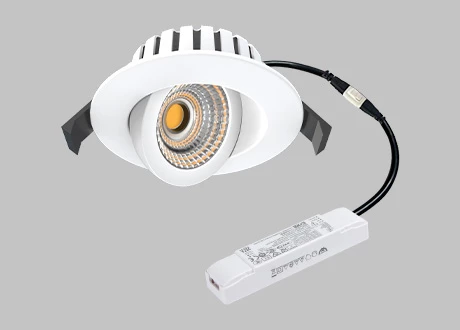
We agree. Good recessed lighting should create contrast between light and shadow while keeping the source out of sight. High-quality downlights remain the most effective solution for bathroom task and accent lighting. A-ONE’s recessed downlights combine excellent airtightness with optimized optics, delivering a clean “light without the fixture” effect—adding depth and a more refined feel to the space.
The Value of Dimmable Lighting
The bathroom is a sanctuary for relaxation. We recommend dimmable solutions for every project. Our new DALI dimmable downlights use high-CRI COB sources for smooth 10%–100% dimming. This allows users to enjoy bright 4000K light for morning routines and a warm, candle-like glow for an evening soak.
Anti-Glare Matters More Than You Think
In spaces filled with reflective tiles and mirrors, anti-glare is crucial. Standard lights create harsh glare spots on wet surfaces. A-ONE’s bathroom series uses specialized optical lenses to keep UGR (Unified Glare Rating) to a minimum.
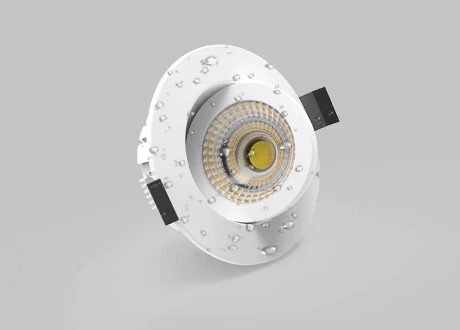
As a lighting manufacturer with 18 years of OEM/ODM experience in Europe, A-ONE believes that bathroom lighting is more than just a list of technical specs. It is a systematic balance of safety, cost, experience, and long-term efficiency.
We do not encourage over-specifying for a higher budget, nor do we accept compromising safety in high-risk zones. True professionalism means placing the right product in the right location. By combining solid sealing techniques, rigorous optical design, and traceable test reports, we provide lighting solutions that stand up to both time and regulation.
 What is Anti-glare Downlight?


 2F, Building 2, Zhongda Industrial Park, Dongshan Industrial Street, Zhangmutou Town, Dongguan, Guangdong 523619, China