 Home
HomeHow Many LED Downlights Do You Need? A Complete Guide to Layout and Calculation
 A-ONE LED Lighting
 May 07,2026

When designing a modern interior, lighting is no longer just a functional necessity; it is a critical element of architectural aesthetics. Among the various fixtures available, the LED downlight has become the gold standard for creating clean, unobtrusive, and efficient illumination.
However, the most common question homeowners and contractors ask is: "How many LED downlights do I actually need?" Install too few, and you end up with gloomy corners; install too many, and your ceiling looks like a "swiss cheese" runway.
In this guide, we will break down the technical differences between lighting types, explore how to choose the right fixtures, and provide a step-by-step calculation method to perfect your lighting plan.
1. Understanding the Basics: What Exactly is an LED Downlight?
Before we dive into calculations, let's clarify the terminology. In the industry, the terms LED downlight and recessed light are often used interchangeably, but there are subtle distinctions.
LED Downlights vs. Recessed Lights
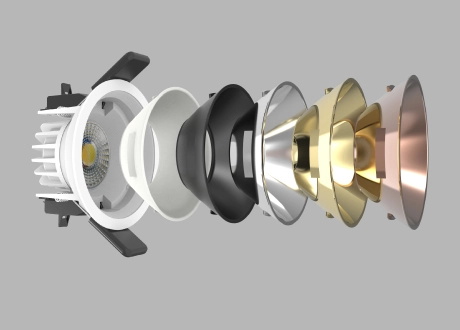
●Recessed Lights: This is a broad category referring to any light fixture installed into a hollow opening in a ceiling (or wall). It consists of three parts: the housing (the "can" inside the ceiling), the trim (the visible part), and the light source.
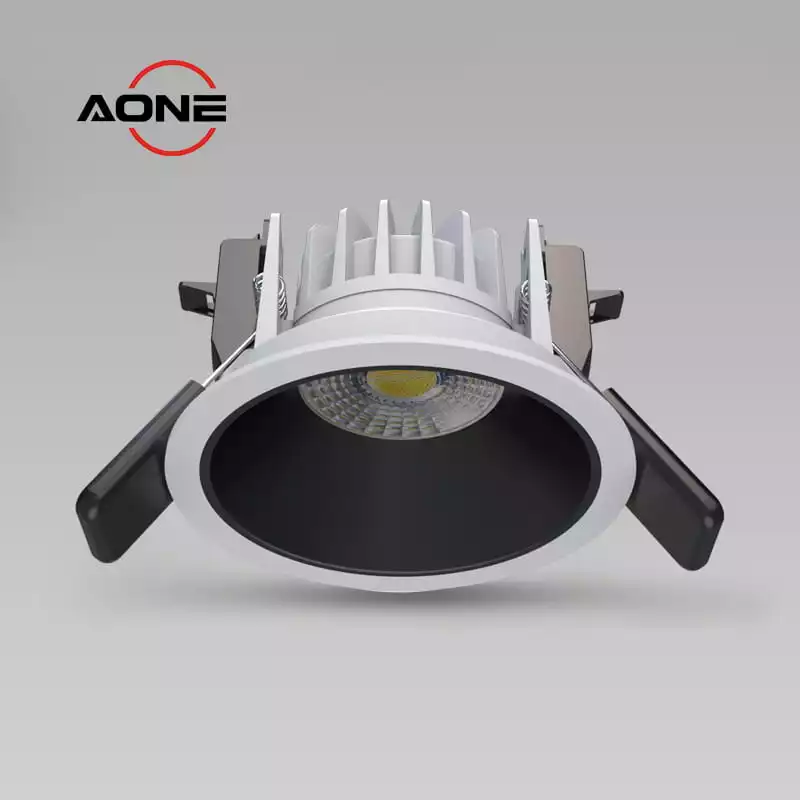
●LED Downlights: Historically, a "downlight" referred specifically to the direction of the light. Today, an LED downlight typically refers to a modern, integrated unit where the LED chip and the trim are one single component. They are thinner (often "wafer" style), more energy-efficient, and easier to install than traditional recessed cans.
Why Choose LED Downlights?
Unlike traditional incandescent or halogen bulbs, an LED downlight offers:
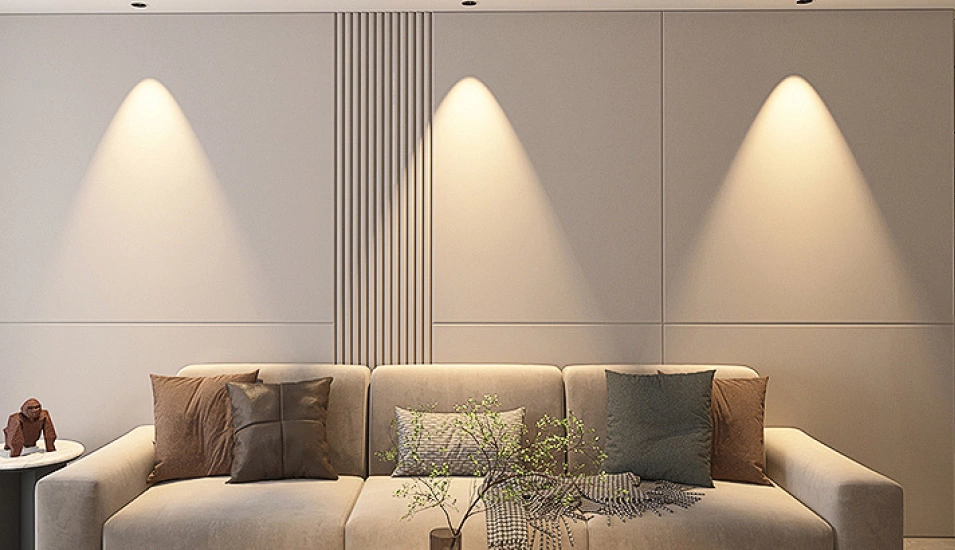
●Directional Lighting: It focuses light downwards, making it perfect for task lighting or highlighting specific areas.
●Space-Saving: Because they are flush with the ceiling, they are ideal for rooms with low clearance.
●Energy Efficiency: Modern LEDs use up to 80% less energy and last 25,000 to 50,000 hours.
2. How to Choose the Right Type of LED Downlight
Not all downlights are created equal. To calculate the quantity correctly, you first need to decide which type of light you are using, as the beam angle and brightness (lumens) significantly impact the layout.
A. Fixed vs. Gimbal (Adjustable)
●Fixed Downlights: These point straight down. They are best for general ambient lighting in hallways, kitchens, and living rooms.
●Gimbal Downlights: Also known as "eyeball" lights, these allow you to tilt the inner frame to direct light toward a piece of art or a workspace.
B. Beam Angles: Wide vs. Narrow
The beam angle determines how much the light spreads.
●Narrow Beam (15°–30°): Best for accent lighting or high ceilings.
●Medium Beam (40°–60°): The standard choice for most residential homes.
●Wide Beam (Over 60°): Ideal for general "wash" lighting to cover large areas with fewer dark spots.
C. Color Temperature (CCT)
The "vibe" of your room depends on the Kelvin (K) rating:
●3000K (Warm White): Best for bedrooms and living areas.
●4000K (Cool White/Neutral): Ideal for kitchens, bathrooms, and offices.
●5000K (Daylight): Recommended for garages or high-precision workspaces.
3. The Step-by-Step Calculation: How Many Do You Need?
Calculating the number of LED downlight units requires a mix of mathematical formulas and design "rules of thumb."
Step 1: Measure the Room (Square Footage)
First, find the total area of your room.
Formula: Length × Width = Total Square Footage (or Square Meters)
Example: A kitchen that is 4m long and 3m wide is 12m².
Step 2: Determine the Desired Foot-Candles or Lux
"Lux" is a measure of how much light falls on a surface. Different rooms require different levels of brightness:
●Kitchen/Office: 300–500 Lux (Bright, focused)
●Living Room/Bedroom: 100–200 Lux (Soft, ambient)
●Bathroom: 200–300 Lux
Step 3: Calculate Total Required Lumens
Now, determine the total light output (Lumens) needed for the space.
Formula: Total Lumens = Lux Requirement × Room Area
Example (Kitchen): 400 Lux × 12m² = 4,800 Lumens.
Step 4: Divide by the Downlight's Output
Check the specifications of the LED downlight you plan to purchase. A standard 9W-12W LED downlight usually produces around 800 Lumens.
Formula: Number of Lights = Total Required Lumens ÷ Lumens per Lamp
Example: 4,800 Lumens ÷ 800 Lumens = 6 Downlights.
4. The Expert "Rules of Thumb" for Layout
While the math gives you a number, the placement ensures the quality of the light.
1. The Ceiling Height Rule
A common industry standard is to space your downlights at half the distance of the ceiling height.
●If your ceiling is 2.4 meters (8ft) high, space your lights roughly 1.2 meters (4ft) apart.
2. The Wall Gap Rule
Never place a downlight too close to a wall, as it creates "hot spots" and shadows. Aim for a distance of 50cm to 75cm away from the wall to allow the light to wash down evenly.
3. Avoid "Shadow Casting"
In kitchens, ensure downlights are positioned over the edge of the countertop rather than behind where you stand. This prevents your body from casting a shadow over your workspace.
5. Factors That Can Change Your Calculation
●Dark Walls & Floors: If your room has dark navy walls or dark wood floors, they will absorb light rather than reflect it. You may need to increase your downlight count by 20%.
●Dimming Capabilities: It is always better to install a few extra lights and use a high-quality dimmable LED downlight. This gives you the flexibility to have "surgical" brightness for cleaning and "mood" lighting for relaxing.
●Ceiling Obstructions: Be mindful of joists, HVAC ducts, and fire sprinklers. Using ultra-slim LED downlights can help you bypass these structural hurdles without changing your layout plan.
Choosing the right number of LED downlight fixtures is a balance between technical calculation and environmental intuition. By understanding your room's purpose, selecting the appropriate beam angle, and using the Lux-to-Lumen formula, you can create a professional-grade lighting environment.
At A-ONE, we specialize in high-performance LED downlight solutions for residential and commercial projects. From 5-year warranties to full customization of CCT and CRI, we provide the hardware you need to bring your vision to light.
Ready to upgrade your space? Contact our engineering team today for a customized lighting layout and high-quality OEM manufacturing services.
 Why DALI dimming is becoming the go-to choice for commercial lighting


 2F, Building 2, Zhongda Industrial Park, Dongshan Industrial Street, Zhangmutou Town, Dongguan, Guangdong 523619, China