 Home
HomeHow to import LED downlights from China?

 May 09,2026

In modern commercial and industrial buildings, LED downlights have become a core product in the lighting market due to their superior energy efficiency, flexible light distribution design, and high spatial adaptability. China, as the world's largest lighting equipment manufacturing base, boasts a highly mature industrial cluster. However, behind the vast amount of information lies a significant difference in quality. For international buyers, finding an excellent LED downlight supplier is not just about finding the lowest price, but also about finding a technical partner who can support the brand's reputation.
This guide will analyze the underlying logic, evaluation dimensions, and end-to-end management solutions for sourcing LED downlights in China based on in-depth industry insights.
Core Logic: A Supplier Evaluation Model Beyond Price
Many novice buyers, when looking for LED downlight suppliers, often start by asking for quotes. However, in the lighting industry, "cheap" often means compromises made in unseen areas. A mature evaluation model should include the following four core dimensions:
1. Industry Accumulation and Production Stability
Experience is a guarantee of quality. Companies with more than 10 years of history in the LED industry have typically experienced multiple technological iterations (from traditional SMD to COB, and then to smart lighting). Extensive experience means they possess:
Stable production processes (SOPs): Reduce human error.
Mature supply chain relationships: Ability to obtain raw materials from international brands at more favorable prices.
Historical defect database: Ability to avoid common heat dissipation or driver failure issues during the design phase.
2. In-depth verification of international compliance certifications
Certifications are not only entry barriers but also endorsements of product safety.
CE & RoHS: Basic requirements for the European market, ensuring electrical safety and environmental protection.
UL/ETL: Essential for entering the North American market, with stringent requirements for fire resistance ratings and high-voltage testing.
ISO9001: Assessing whether suppliers have systematic quality control processes, rather than relying solely on worker compliance.
LM-79/LM-80: Professional suppliers should provide these optoelectronic performance and lifespan test reports, demonstrating the light decay performance of their LED chips.
3. Hardware breakdown: An "all-star" combination of top-tier components
A high-end LED downlight supplier never shies away from discussing the sourcing of their raw materials.
LED Chips: Prioritize CREE, OSRAM, Bridgelux, or Philips. These brands offer chips with higher color rendering index (CRI > 90) and better color consistency (SDCM < 3).
Drivers: Drivers are the most vulnerable part of the luminaire. Industry-recognized reliable brands include Li-Fud, Eaglerise, or MeanWell.
Heat Sinks: Observe whether the housing is die-cast aluminum or cold-forged aluminum. Excellent heat dissipation design significantly extends the effective lifespan of LEDs.
4. OEM/ODM Technical Customization Capabilities
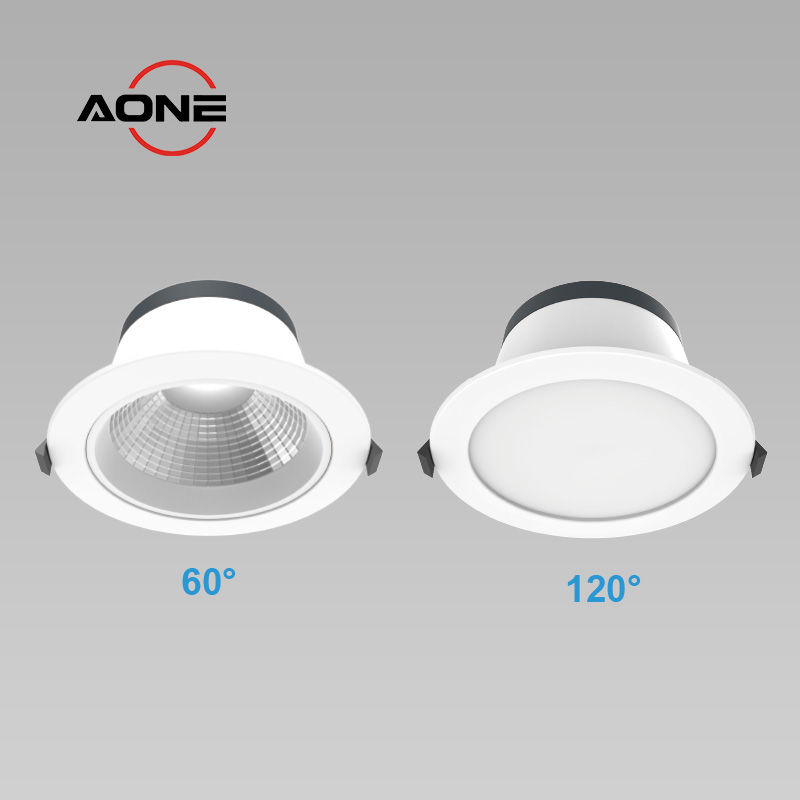
If a supplier can provide customized beam angles (15°/24°/36°), different color temperature (CCT) options, or support for intelligent system integration (such as DALI, Zigbee, Matter), it indicates they have an independent technical team, not just an assembly plant.
Further Exploration: Quality Grading and the Truth About "Made in China"
"Made in China" is a very broad term. Understanding its internal grading logic helps buyers identify the most suitable LED downlight suppliers.
1. Why the Huge Price Differences?
In the markets of Shenzhen, Zhongshan, or Ningbo, downlights with almost identical appearances can have prices that differ by 3-5 times.
Low-end Market: Uses recycled aluminum, inferior resistors and capacitors, and unbranded domestic chips. These products have acceptable initial brightness, but suffer severe light decay after 3-6 months, even posing a fire hazard.
High-end Manufacturing: Many top Chinese factories are actually OEM manufacturers for major European and North American brands. They implement international standard quality control. Although their prices are slightly higher, considering their extremely long lifespan and very low after-sales return rate, they offer the best overall cost-effectiveness.
2. Geographical Distribution of Suppliers
Dongguan, Guangdong: The stronghold of intelligent lighting and high-end customization, with the strongest technical capabilities.
Zhongshan (Guzhen), Guangdong: A global lighting capital with an extremely complete industrial chain, suitable for finding high-quality, cost-effective mid-range products.
Ningbo/Shangyu, Zhejiang: Specializes in large-scale automated production, suitable for standardized orders from retail giants.
Practical Process: Seven Steps from Supplier Finding to Delivery
To ensure the success of your procurement project, you need a standardized operating procedure:
Step 1: Precise Supplier Screening
Utilize Alibaba, Global Sources, or participate in the Canton Fair or Hong Kong International Lighting Fair. During the initial screening, prioritize factory size, export volume ratio, and whether they possess independent R&D patents.
Step 2: Multi-Dimensional Sample Testing
Samples are not just about brightness. You need to test:
Aging Test: Observe stability after 72 hours of continuous lighting.
Flicker Test: Use a mobile phone or professional instruments to check if the driver has anti-flicker functionality.
Color Temperature Consistency: Compare multiple samples for color deviation.
Step 3: On-Site Factory Audit
Theoretical research is no substitute for on-site inspection. Check their raw material warehouse, assembly line, aging test chamber, and pre-shipment IQC (Incoming Quality Control) and OQC (Outgoing Quality Control) records. If you cannot visit in person, you can hire a third-party organization such as SGS.
Step 4: Business Negotiation and Contract Signing
Key Word: Clarity.
Don't just discuss the total price; break it down into details: driver brand, chip model, warranty period (3-5 years recommended), and failure rate compensation clauses. Ensure all commitments are reflected in the Proforma Invoice (PI) or purchase contract.
Step 5: Production Progress Monitoring
Regularly request photos or videos of the production progress from the supplier. For large-volume orders, it's recommended to conduct random checks mid-production to avoid discovering batch problems only after completion.
Step 6: Efficient Logistics and Customs Clearance
Choose FOB (Free On Board) or CIF (Cost, Insurance, and Freight) based on the urgency of the order. Partner with professional freight forwarders to ensure complete documentation such as bills of lading, packing lists, and certificates of origin, reducing customs clearance risks.
Step 7: Arrival Inspection and Feedback
Conduct an immediate unpacking inspection upon receipt. Even if the product is fine, provide feedback to the supplier; this helps build a long-term, stable cooperative relationship.
Industry Outlook: New Trends in Future LED Downlight Procurement
With technological advancements, future competition among LED downlight suppliers will focus on the following three areas:
1. Human Centric Lighting
More than just illumination, it's about regulating mood. Suppliers supporting adjustable white color temperature and simulating natural light variations will be more favored by the market.
2. Sustainability and ESG
Global buyers are increasingly focused on carbon footprint. Factories using environmentally friendly and recyclable materials (such as renewable aluminum) and minimalist packaging will be more competitive in future trade.
3. Modular Design
For ease of maintenance, future downlights will trend towards fully modular design for the light source, driver, and frame. This not only reduces inventory pressure but also allows for easy replacement of damaged components, aligning with the global trend of energy conservation and emission reduction.
Conclusion
Choosing a suitable LED downlight supplier is a systematic project that requires buyers to have both a keen eye for hardware parameters and a rigorous approach to supply chain management. The Chinese market offers lighting solutions ranging from entry-level to world-class; the key is your ability to filter them precisely using the professional process described in this article.
Adequate preparation, transparent communication, and a commitment to quality will ensure your procurement projects not only save you money but also add value to your brand. In this vibrant market, finding a trustworthy partner is the first step towards successful trade.
 How to Select Top-Tier LED Downlight Manufacturers


 2F, Building 2, Zhongda Industrial Park, Dongshan Industrial Street, Zhangmutou Town, Dongguan, Guangdong 523619, China