 Home
HomeWhy Your Lighting Project Needs Anti-Glare Features?

 Jan 08,2026

When designing a lighting project, most people focus on visible parameters such as power, colour temperature, colour rendering index (CRI), and luminous efficacy. While these parameters seem comprehensive, the actual result often falls short once the luminaires are installed—the light feels too harsh. This is usually due to one critical factor being overlooked: glare.
Glare has a strong impact on lighting comfort and eyes. In offices or residential lighting, long-term exposure can cause eye strain, fatigue, and even headaches. In commercial spaces, glare can reduce product appeal and make the environment feel low-end. This is why anti-glare design is essential.
What is glare
According to CIE, glare is defined as: "a condition of vision in which there is discomfort or a reduction in the ability to see details or objects, caused by an unsuitable distribution or range of luminance, or by extreme luminance contrasts." In lighting applications, glare is influenced by fixture placement, light distribution, and beam angle. It can be divided into two types:
Discomfort glare: glare that causes discomfort without necessarily impairing the vision of objects.
Disability glare: glare that impairs the vision of objects without necessarily causing discomfort
How to quantify discomfort glare
We use the Unified Glare Rating (UGR) to measure discomfort glare in indoor lighting environments. UGR values typically range from 10 to 30 (the theoretical range is 5–40). A lower UGR means less glare and greater visual comfort.
To choose the right UGR for your project, refer to the table below (based on EN 12464-1):
|
Space Type
|
Example Tasks |
Max UGR Limit |
|
Precision/Detailed Work
|
Technical drawing, fine assembly, jewelry |
≤16 |
|
Office/Education
|
Writing, reading, computer work, classrooms |
≤19 |
|
General Industry/Retail
|
Medium-precision tasks, sales areas |
≤22 |
|
Circulation/Auxiliary Areas
|
Corridors, stairs, lounges, warehouse aisles |
≤25 |
|
Rough/Heavy Industry
|
General storage, loading areas, heavy assembly |
≤28 |
For more detailed standards, visit:
What does “UGR < 19” mean for a fixture
UGR < 19 is a key benchmark in indoor lighting—especially for offices and workspaces—as it’s the maximum allowable glare limit per European standard BS EN 12464-1:2021 for tasks like computer work, classrooms, and meetings.
When manufacturers label a downlight, spotlight, or panel light as “UGR < 19,” it indicates that the fixture can help achieve UGR < 19 in typical installations—when mounted at standard heights and spacing—not that the fixture itself has a fixed UGR value.
How do UGR < 19 anti-glare fixtures work
Whether it’s anti-glare panel lights for offices or downlights for retail spaces, the goal is to control UGR below 19. Below are common anti-glare solutions for two main product types.
LED anti-glare panel lights
Micro-prism diffuser
A surface covered with micron-scale prism structures controls light exit angles. By refracting and spreading light, it reduces peak brightness and ensures even distribution, minimizing direct glare while maintaining clarity and light output.
Anti-glare film
A film applied to the diffuser surface scatters light through micro-structures (e.g., hexagonal or pyramid patterns). This reduces direct reflections and transforms high-angle light into soft diffused light, lowering perceived brightness and discomfort.
Nano-coating
A nanoscale optical coating on the light-emitting surface selectively scatters or attenuates high-intensity light components. This softens intense light and can improve color performance, further reducing visual irritation.
LED anti-glare downlights
Reflector cup design
The reflector cup is central to downlight glare control. Key features include:
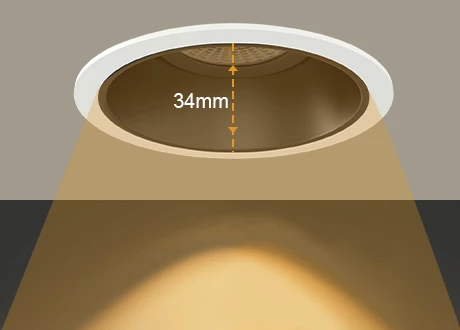
Deep recessed design (cup depth ≥ 30 mm) to hide the light source.
Matte or black interior to absorb stray light.
Large cutoff angle (≥ 30°) to minimize high-angle light leakage.
Lens optics
Lenses refract, soften, or absorb stray light to reduce glare. Common types include:
- Concentrating lens (or COB lens): Usually based on total internal reflection (TIR) or refractive optics.Focuses light into a narrow/medium beam (15°–60°), producing sharp, clean light with minimal spill. Often made of PMMA or PC and used with deep reflectors.
- Diffuser lens (or Frosted lens): Features a frosted surface to spread light broadly (beam > 60°) and soften intensity, ideal for general lighting.
- Honeycomb grid lens: A hexagonal grid pattern breaks light into smaller, indirect beams, absorbing stray light for strong glare control. Often used as an add-on with other lenses.
How to verify true UGR < 19 performance
Subjective judgement such as “the light doesn’t feel harsh” is not enough to confirm compliance with UGR < 19. Objective verification requires a standardised testing and calculation process.
The most authoritative method involves measuring the fixture in a standard IES test room (photometric distribution lab) using a goniophotometer. This generates an IES or LDT file for UGR analysis via professional lighting simulation software.
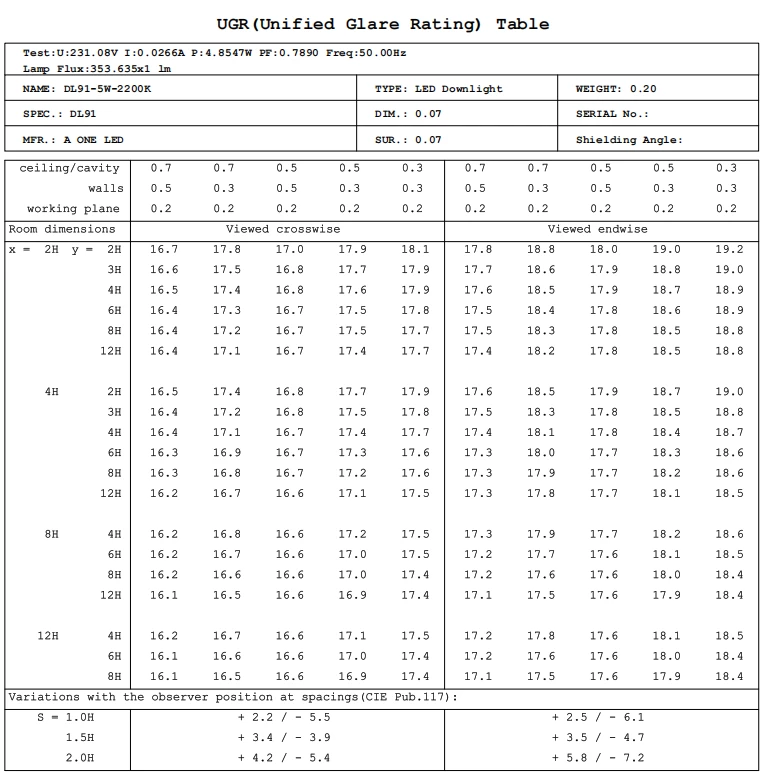
Example test: A-ONE dl91 anti-glare downlight
The “5W–8W Tiltable Dimmable Low-Glare Downlight with 3CCT Selectable (DL91)” was tested in a standard IES test room. The luminaire was mounted on a precision robotic arm to measure light intensity in all directions, generating an accurate IES file.
Standard test conditions include:
Completely dark environment to eliminate stray light
Controlled temperature and humidity
Standardised test distances, angles, and mounting methods
Performance highlights:
- Recessed depth: 34 mm for effective glare control.
- UGR < 19 from both lateral and longitudinal views.
- Interchangeable reflector cups (white/black/chrome/brushed nickel/gold).
- High efficacy up to 100 lm/W while maintaining low glare
- Beam angles of 38° and 60° for different applications
- 4 CCT options (2700K–5700K) with dim-to-warm feature,enabling precise ambience control
Q&A
Q1: Is UGR < 19 necessary on a tight budget?
Depends on space use. For offices, classrooms, or shops where people spend long hours, investing in anti-glare fixtures pays off in comfort and productivity. For corridors or warehouses, standards can be relaxed.
Q2: Does anti-glare reduce brightness?
Not with good design. Proper optics direct light where needed and minimize wasteful glare, maintaining high efficiency. Well-designed anti-glare fixtures can still achieve high luminous efficacy.
Q3: What else to consider when choosing anti-glare downlights?
Key factors: cutoff angle (>30°), optical finish (e.g., matte black reflector), and availability of third-party IES test reports with specific UGR data.
Q4: Is anti-glare related to flicker?
No direct link. Flicker depends on driver quality. However, high-quality anti-glare fixtures often use premium drivers, delivering both flicker-free and low-glare performance.
References
1. International Commission on Illumination (CIE). Glare [EB/OL]. CIE S 017/E:2020 International Lighting Vocabulary. https://cie.co.at/eilvterm/17-22-098
2. International Commission on Illumination (CIE). Disability glare [EB/OL]. CIE S 017/E:2020 International Lighting Vocabulary. https://cie.co.at/eilvterm/17-22-103
3. International Commission on Illumination (CIE). Discomfort glare [EB/OL]. CIE S 017/E:2020 International Lighting Vocabulary. https://cie.co.at/eilvterm/17-22-102
4. British Standards Institution (BSI). BS EN 12464-1:2021 Light and lighting - Lighting of work places - Indoor work places [S]. https://knowledge.bsigroup.com/products/light-and-lighting-lighting-of-work-places-indoor-work-places
 GU10 Downlights: In-Depth Guide & Fixture Selection


 2F, Building 2, Zhongda Industrial Park, Dongshan Industrial Street, Zhangmutou Town, Dongguan, Guangdong 523619, China