 Home
HomeWhy Choose Casambi Technology for LED Downlights?
 A-ONE LED Lighting
 Jun 26,2026

With the rise of smart buildings and human-centric lighting, intelligent solutions for LED downlights have become one of the most popular trends in the global lighting industry. In recent years, a new wireless control system has drawn strong interest — casambi lighting.
A user once praised it online: “I must admit, it performs perfectly so far. The experience is excellent, programming is simple, it’s easy to deliver and demonstrate the controller to clients, and it runs very stably.” Is this praise accurate? Can Casambi really deliver such a transformative experience? In this article, A-ONE provides a complete analysis to help you decide if this system is right for your lighting projects.
What is the Casambi Control System
Core Concept of Casambi
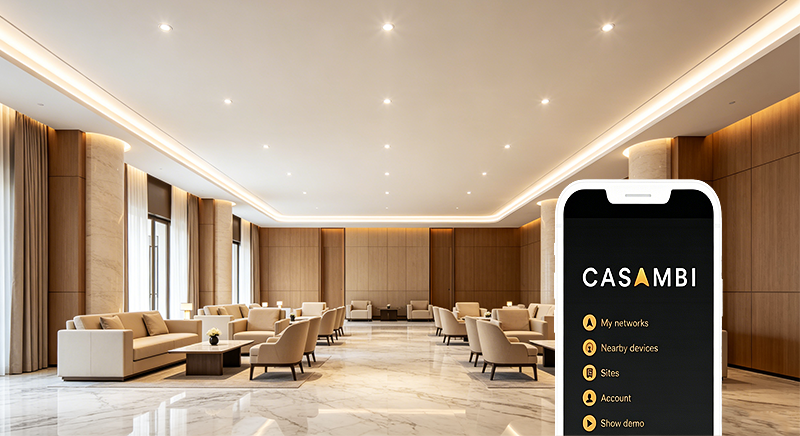
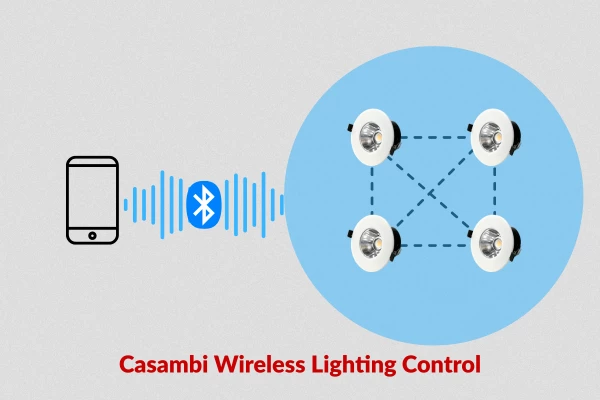
Casambi is a decentralized wireless smart lighting control system based on Bluetooth Low Energy (BLE) Mesh technology. Designed for modern architecture, casambi lighting requires no central controller, no complex wiring, and no wall demolition. Its compact control module can be easily integrated into luminaires, LED drivers, LED modules, switches, sensors, and various control units.
Differences from Traditional Wired and Wireless Systems
Traditional wired systems (such as classic DALI and KNX) require extensive dual-bus control cabling from the design stage. This brings high material costs, complicated installation, and time-consuming on-site programming by specialist engineers.
Traditional wireless solutions (like some Zigbee or Wi-Fi systems) still rely heavily on gateways or routers. If a gateway fails, large areas of lighting can lose control.
Casambi simplifies everything by packing intelligence into a tiny module. There is no need for a central controller or dedicated gateway. This gives installers and end users direct, flexible control.
How Does the Casambi System Work
Casambi offers multiple easy control options — mobile app, wireless panels, and automated scenes — without complex programming.
Mobile App Control
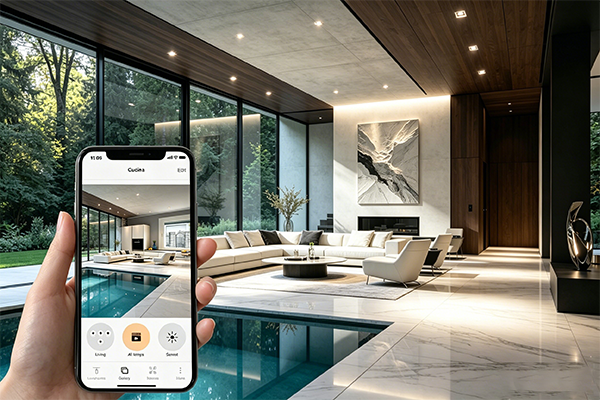
The Casambi App (available for iOS and Android) is the main control interface. Users can group lights, adjust brightness and color temperature, create scenes, and even upload floor plans or photos via the Gallery function for intuitive, visual control. It also supports timers, motion sensors, daylight sensors, and automated logic.
Wireless Control Panels
For those who prefer physical switches, Casambi provides wireless wall panels. These can be programmed for one-touch scene activation, require no wiring, and run on batteries or energy harvesting. Their elegant design fits perfectly into high-end interiors.
Wall Switch Integration and Expansion
Casambi modules can be installed inside existing wall switch boxes or directly into luminaires and drivers. This allows smooth combination of traditional switches and smart control. The system also integrates with sensors and gateways for connection to advanced Building Management Systems (BMS).
Suitable Project Types
New Construction Projects
In new buildings, Casambi’s wireless Mesh technology eliminates the need for extra control cables. Installers follow standard procedures for luminaires and drivers, then simply add Casambi modules. This shortens installation time and reduces labor costs. Future layout changes can be handled easily through the app without reconstruction.
Retrofit and Renovation Projects
Many hotels, malls, offices, and historic buildings want to upgrade to smart lighting for better energy efficiency and user experience. Traditional wired upgrades often require opening ceilings and installing new cables, which is costly and disruptive.
To solve this, casambi lighting offers a much simpler path: replace or add modules to existing drivers. The upgrade is fast, non-invasive, and ideal for historic buildings and museums where preserving structure is essential.
Real-World Experience in Different Applications
- Commercial Spaces: In shopping malls and hotel lobbies, Casambi enables precise zoning and automatic adjustments based on time or occupancy. This improves the customer experience while saving energy.
- High-End Residences: Homeowners can control individual areas or create whole-house scenes such as “Welcome Home”, “Movie Night”, or “Sleep Mode”. Multiple users can share the system with different permissions for convenient daily living.
- Retail and Display Spaces: Retail stores can use focused lighting to precisely highlight product features and quickly switch between different promotional atmospheres. Dynamic lighting not only effectively captures customers’ attention but also significantly boosts store conversion rates and sales performance.
- Museums and Galleries: Precise control of brightness and color temperature protects artworks. Lighting scenes can be updated quickly when exhibitions change, without scaffolding or major disruption. Many leading venues already use Casambi successfully.
How Casambi Empowers LED Downlights: Two Main Technical Approaches
Currently, integrating Casambi functionality into LED downlights is achieved through two main technical paths: the External Module Approach and the Built-in Integration Approach, both of which offer distinct pros and cons tailored to different project requirements.
Approach 1: External Module Solution — Flexible and Retrofit‑Friendly
The External Module Approach involves connecting an independent Casambi Bluetooth Unit (CBU), such as the CBU‑ASD or CBU‑ARP, to an existing LED driver, instantly upgrading traditional luminaires with wireless smart control capabilities.
Typical Configuration:LED Downlight + Existing LED Driver + External Casambi Control Module.
The external module functions as a stand‑alone Bluetooth node that receives wireless commands from the mobile app and converts them into wired control signals—such as 0‑10 V, DALI, or PWM—that the driver can decode to adjust dimming and colour temperature.
Key Advantages
High Adaptability: You can add Casambi control to existing downlights without changing the original LED drivers, making it the premier choice for retrofitting established lighting systems.
Flexible Maintenance: The control module can be replaced or upgraded independently, which significantly simplifies future maintenance without disturbing the luminaire itself.
Main Drawbacks
Increased Component Count: Requiring a separate unit for each fixture increases the number of SKUs and adds extra manual wiring steps on-site.
Spatial Constraints: The module requires dedicated physical space inside the ceiling cavity or junction box, which can pose a challenge in tight or shallow installations.
Higher Overall Cost: Introducing extra external hardware and additional assembly steps inevitably drives up both material and labor costs.
Approach 2: Built-In Integration Solution — Compact and Cost‑Effective
The Built-in Integration Solution involves utilizing lighting hardware that directly embeds the Casambi Bluetooth Module (CBM, typically the tiny CBM‑003A series) into its internal circuitry straight from the factory.
Three Versatile Integration Methods: The embedded core module is exceptionally compact (measuring only approx. 12.7 mm × 20.0 mm, smaller than a coin) and contains both the Bluetooth radio and the Casambi firmware:
Inside the LED Driver: Driver manufacturers place the CBM module directly on the driver’s PCB, creating a “Casambi‑Ready” intelligent driver that can be paired with any standard LED light source. This is currently the most prevalent method.
Inside the Luminaire: Luminaire makers embed the module into the downlight’s own circuit board, so the whole fixture becomes a smart device the moment it is connected to mains power.
On the LED Module: For architectural lighting with modular designs, the Casambi chip can be mounted directly on the LED module itself, achieving the most compact, unified product structure.
Key Advantages
Significant Cost Reduction: By eliminating the need for a standalone external control unit, this approach reduces component counts and drastically lowers total procurement and material costs.
Much Simpler Wiring: The end user simply connects the system to the mains supply exactly like a conventional non‑smart downlight, eliminating the need for specialized installer training and reducing labor time.
Zero Extra Footprint: Everything is contained within the product housing, requiring no extra ceiling space, which is a massive advantage in restricted or shallow ceilings.
Higher System Reliability: Minimizing physical connection points and external contacts significantly mitigates the risk of system failures caused by loose connections or external module damage.
Best Suited For: New construction projects requiring rapid smart deployment, large‑scale commercial deployments where installation speed matters, and OEM/ODM projects demanding a highly integrated solution.
A-ONE’s Casambi Smart Lighting Solution
With 18 years of LED lighting manufacturing experience, A-ONE is at the forefront of technology. We have developed a practical Casambi lighting solution for B2B buyers, designers, and contractors.
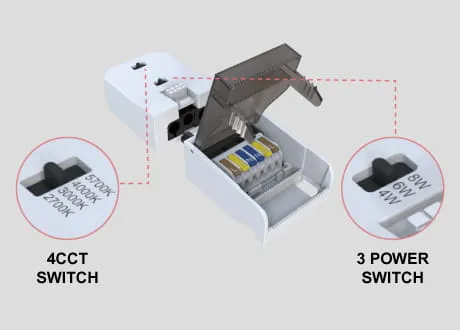
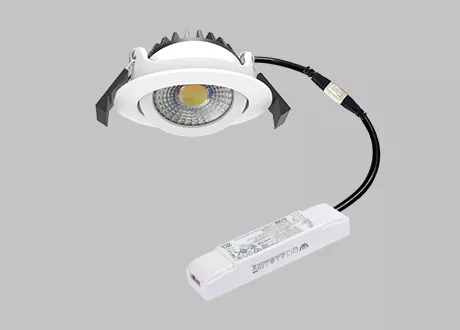
Our LED downlights and spotlights can seamlessly integrate Casambi modules. We mainly offer two compatible approaches:
A-ONE Casambi Triac (Phase-Cut) Solution
Ideal for small to medium commercial spaces, offices, and residential retrofits. Using our high-quality Triac-dimmable downlights with Casambi modules, you get full wireless Mesh intelligence at a competitive cost. Installation is straightforward and perfect for fast upgrades.
A-ONE Casambi DALI Solution
Designed for projects requiring deep dimming (down to 0.1%), fine grouping, and professional performance — such as museums, galleries, high-end retail, and luxury villas. Our downlights use certified BOKE DALI-2 drivers paired with Casambi modules. This combines DALI’s excellent digital dimming quality with Casambi’s powerful wireless convenience for precise, stable, flicker-free lighting.
We also provide driver selection guidance, sample testing, and OEM/ODM services to help clients reduce risks and improve project delivery.
FAQ
Q1: How would you summarize Casambi in a few words?
Decentralized, wireless, flexible, easy to deploy, and open.
Q2: How many LED downlights can one Casambi network support?
A single network supports up to 250 nodes. Larger projects can link multiple networks for control of thousands of lights.
Q3: How is wireless performance in commercial buildings?
Every luminaire acts as a signal repeater. Typical indoor distance between nodes is around 30 meters. The Mesh network extends coverage flexibly, though we recommend site testing for complex spaces.
Q4: Can A-ONE’s solution work with other brands’ panels and sensors?
Yes. Any “Casambi Ready” product can join the network, supporting our open ecosystem philosophy.
 SMD vs. COB Downlights: A Decision Guide


 2F, Building 2, Zhongda Industrial Park, Dongshan Industrial Street, Zhangmutou Town, Dongguan, Guangdong 523619, China