 Home
HomeIdeal CRI for LED: Why It Matters?

 Feb 27,2026

In the 21st century, lighting value has evolved from basic illumination to Human-Centric Lighting (HCL). The quality of the light spectrum has become a core metric for assessing building space quality. For European wholesalers and contractors, the Color Rendering Index (CRI) is no longer just a technical spec—it is a strategic driver of client satisfaction, project compliance, and premium pricing.
As a LED lighting factory with 18 years of manufacturing experience, we A-ONE understand that high-quality light sources do more than restore colors—they bring spaces to life.
What is Color Rendering Index?
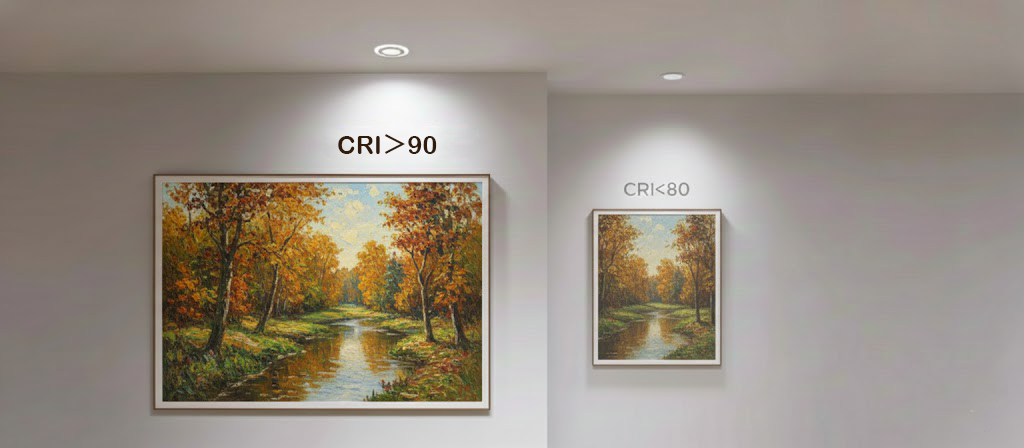
Color Rendering Index (CRI) measures how accurately a light source shows colors compared with a natural reference, such as sunlight or an incandescent lamp. The International Commission on Illumination (CIE) developed this 0–100 scale, where 100 represents the most accurate color rendering. In LED lighting, a higher CRI makes colors look more vivid and natural, which matters in spaces where color accuracy is essential.
Recommended CRI Ranges for Selection?
For various applications in the European lighting market, CRI selection can be categorized as follows:
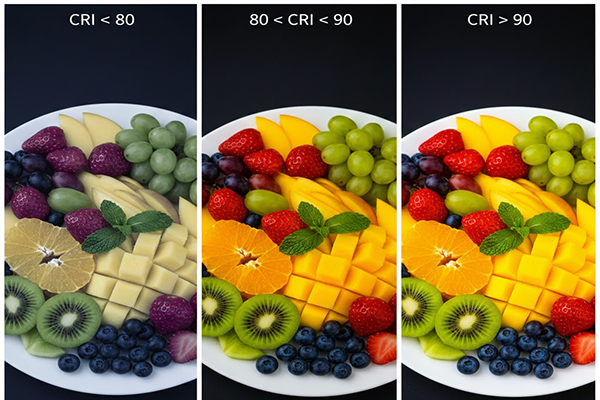
CRI 90+: Exceptional Visual Excellence
• Applications: Art galleries, luxury retail stores, dental clinics, high-end residences, photography studios.
• Visual Features: Extremely high color saturation, sharp object details, nearly indistinguishable from natural light to the naked eye.
• Business Value: In retail settings, CRI 90+ lighting significantly enhances the "appeal" of goods—for instance, the texture of expensive leather or the sheen of silk fully shines under high-CRI light, directly reducing return rates due to color discrepancies.
CRI 80-90: Mainstream Commercial Standard
• Applications: Modern offices, school classrooms, hotel rooms, supermarkets.
• Visual Features: Basic accurate color reproduction, meeting most daily activities' requirements for visual comfort.
• Industry Status: This is the general entry threshold for indoor lighting in the European market (complying with CE/UKCA standards).
CRI Below 80: Functional Lighting
• Applications: Industrial warehouses, outdoor parking lots, streetlights, building facade floodlighting.
• Visual Features: Colors may appear "pale" or "grayish."
• Selection Logic: In these scenarios, shape recognition and brightness take priority over color accuracy, with contractors focusing more on energy efficiency and maintenance costs.
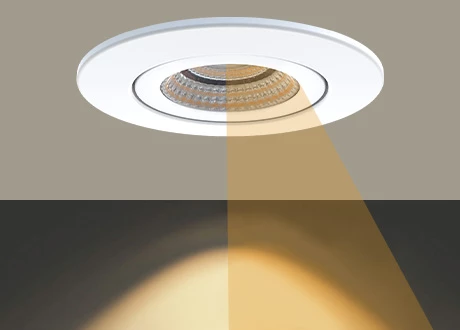
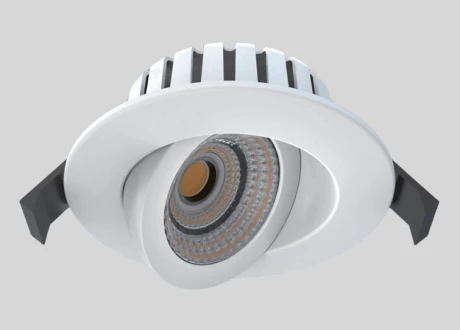
A Versatile Solution for All Scenarios: To meet contractors' needs across budgets and applications, A-ONE's "Fire-Rated Downlight Dimmable IP65 DL127-7P" offers high customization flexibility: This model not only comes with CRI >80 to meet everyday commercial standards but can also be customized to CRI >90 for premium projects.
Why is CRI Important for LED Lighting?
For wholesalers and contractors, understanding CRI's importance is not just a technical necessity—it's a business strategy:
Customer Satisfaction
End-users might not know what CRI is, but they can intuitively feel "this light makes the home look lifeless." Low CRI can cause skin tones to appear bluish or food to look dull, leading to psychological discomfort. Offering high-CRI products significantly reduces post-delivery complaints about visual unease.
Project Delivery Quality
European building codes (like EN 12464-1) specify CRI requirements for different venues. To pass audits from governments or multinational corporations, contractors must use third-party certified high-CRI fixtures. In response, A-ONE provides the same product with customizable CRI >80 or >90, ensuring one-time compliance.
Product Premium Pricing
The market for basic fixtures is saturated. Products with high CRI (>90) combined with high luminous efficacy offer brands and distributors greater profit margins. By emphasizing "color fidelity" and "light health," you can avoid low-price competition and target mid-to-high-end clients.
Human-Centric Lighting
HCL is a cutting-edge topic in Europe's lighting industry, with high CRI as its foundation. Physiological Regulation: A complete spectrum helps regulate the body's circadian rhythm. Mental Health: Light close to natural reduces visual fatigue, boosts office productivity, and eases anxiety in enclosed spaces.
What Parameters are Easily Confused with CRI?
Many confuse CRI with correlated color temperature (CCT), or assume TM-30 is an "upgrade" to CRI, opting for one over the other. In fact, these three form a coordinate system for evaluating light source color, but with distinct roles.
CRI vs. TM-30
• TM-30: A next-generation color rendering system from the Illuminating Engineering Society of North America (IES), including two core metrics—Rf (fidelity) and Rg (gamut).
• Difference: CRI tells you if colors are "accurate," while TM-30 indicates if they are "vivid."
CRI vs. CCT
• CCT (Correlated Color Temperature): Measures light's "warmth" or "coolness" (e.g., 3000K warm yellow, 5000K cool white).
• Difference: CCT sets the mood, CRI ensures quality. High CRI is possible at any CCT, from 2700K to 6500K.
How Does a Lighting Factory Ensure CRI Compliance?
CRI assesses a light source's ability to render object colors accurately, primarily tested using an integrating sphere combined with a spectrophotometer or spectrometer. This involves placing the light source in the sphere, illuminating standard color samples, measuring the reflected light's spectral distribution, and comparing it to a reference (like blackbody radiation or daylight) to calculate the CRI value.
At A-ONE, we enforce strict lighting quality control in a dedicated lab. Using large integrating spheres and high-precision spectrophotometers, we measure the full spectrum of every batch. Our system automatically generates Spectral Power Distribution (SPD) charts and calculates Ra and R1–R15 values, providing accurate, traceable results you can rely on.
Q&A
Q1: Why do some cheap fixtures claim CRI 90 but look odd?
This is a common industry pitfall. Some small factories boost the average Ra by adding specific wavelength powders, but the discontinuous spectrum causes noticeable color shifts (e.g., greenish tint). As a trusted factory with 18 years of experience, our test reports include full spectrum graphs and color vector diagrams for genuine light quality.
Q2: Does high CRI mean shorter fixture lifespan?
High-CRI chips do require better heat dissipation. Poor design leads to rapid light decay. Our products use high-thermal-conductivity die-cast aluminum housings and active cooling, ensuring lumen maintenance (L70) meets standards after 50,000 hours, even in Europe's highest ambient temperatures.
Q3: In high-electricity-cost environments, do high-CRI products meet energy efficiency standards?
This is our core strength. Traditional CRI improvements often reduce efficacy, but with the latest high-refractive-index encapsulation materials, our CRI 90+ products maintain high output.
 How Mini Spotlights Redefine Project Efficiency and Aesthetics


 2F, Building 2, Zhongda Industrial Park, Dongshan Industrial Street, Zhangmutou Town, Dongguan, Guangdong 523619, China