 Home
HomeHow to Make a Good Fire-Rated Downlight?
 A-ONE LED Lighting
 Dec 20,2025

Fire risks remain a serious safety concern in modern life. According to UK government statistics, England sees around 25,000–30,000 dwelling fires each year. In dwelling fires, flames often spread rapidly between floors. Downlights are a popular lighting choice, but regular downlights can create a “fire pathway”—an opening that allows flames and smoke to move from one floor to another. Truly safe and effective fire-rated downlights are vital for protecting lives and property.
So, how to make a fire-rated downlight safe and efficient? Materials are key: it needs a metal iron shell and intumescent materials, backed by rigorous testing from certified bodies like SGS or TÜV. This ensures it can prevent fire spread in critical moments, buying vital time for escape and rescue.
What is the Principle Behind Fire-Rated Downlights
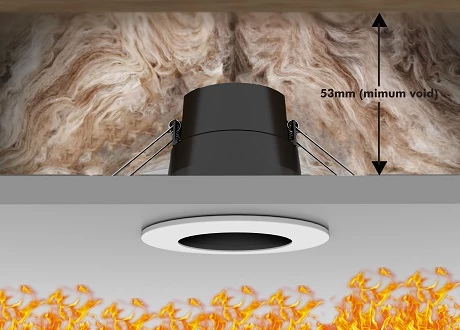
Recessed downlights create holes in ceilings, breaching the fire barrier. A fire-rated downlight must therefore provide its own fire protection. In a fire, it prevents flames and hot smoke from passing upwards through the opening, maintaining the floor's structural integrity and protecting the space above.
What are the Key Elements for Achieving Fire Protection inside a Downlight
Compared to traditional halogen lamps, high-quality fire-rated downlights use premium LED chips to keep surface temperatures low (40–65°C), well below the ignition point of materials like wood, insulation or dust (typically over 200°C). This greatly reduces the risk of the light itself starting a fire.
However, the core of true fire protection is preventing flames and hot smoke from spreading upwards through the ceiling hole during a fire, safeguarding the floor above. Our company's “Fire-Rated LED Downlight Multi-functional DL08” is a good example of effective design.
1. Uses metal iron shell
A metal iron shell offers excellent heat resistance (pure iron melts at around 1538°C, far above typical fire temperatures). In the early stages of a fire, it provides robust physical protection for internal components and wiring, preventing high heat from causing electrical faults or secondary fires.
More importantly, the metal iron shell acts as a strong frame and carrier for the intumescent material, ensuring it stays in place and expands properly under heat to form a reliable seal. Many cheaper products use plastic shells or thin aluminium, which can deform or melt, causing the intumescent material to fail and leave gaps.
2. Use intumescent fire-retardant material
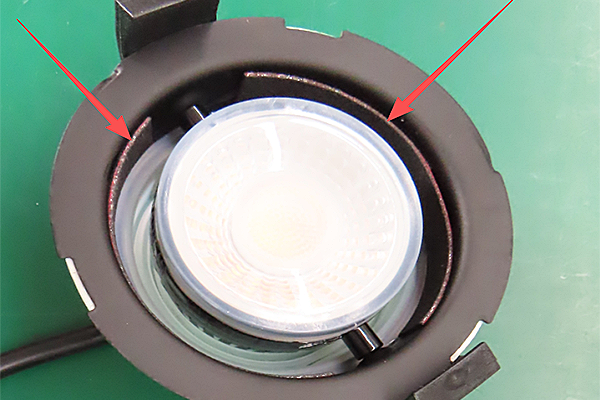
The DL08 also incorporates intumescent material (often called fire-resistant cotton) inside. At high temperatures, it rapidly expands into a dense, charred insulating layer (typically reacting from 150–200°C), fully sealing the gap between the downlight and ceiling. This achieves:
- Flame prevention: Stops fire spreading upwards from below
- Hot smoke blockage: Significantly reduces heat transfer to the floor above
- Structural integrity: Prevents premature ceiling collapse
3. Strict control of spring height
Springs of moderate height (around 30mm) suit most standard ceiling thicknesses, ensuring a tight fit between the light edge and ceiling. This prevents the fitting from sagging or falling during a fire.
For more details on the DL08's appearance, see this link: https://www.youtube.com/shorts/tXOwqvzj2ME
What Guarantees the Fire Performance
Fire-rated downlights must undergo full-system testing by accredited third-party laboratories. They fully comply with current UK building regulations and can be used in new builds, loft conversions, HMOs (Houses in Multiple Occupation), and commercial projects.
Compliance with structural fire integrity standards
The DL08 has been tested as a complete unit to British Standards BS 476-21:1987 and BS 476-22:1987. In common plasterboard ceiling constructions, it maintains fire integrity for the following durations:
- Single 15mm plasterboard layer (joists at 600mm centres): ≥ 30 minutes
- Double 12.5mm plasterboard layers (joists at 600mm centres): ≥ 60 minutes
- Double 15mm plasterboard layers (joists at 450mm centres): ≥ 90 minutes
This meets the requirements of Building Regulations Approved Document B (Fire Safety) for floor separations.
Passed glow-wire flammability test method for end products (GWEPT)
The glow-wire flammability test method for end products (GWEPT), per IEC 60695-2-11, simulates fire risks from overheated components. It is commonly used in safety certifications (e.g., CE, CCC) to assess flammability of plastics and insulation.
Samples from the DL08 – including the junction box, translucent cover, driver housing, switch protector, and lens – were tested at 850°C. The glow-wire was applied, and in all cases, any flame or glowing extinguished within 30 seconds, with no dripping that ignited tissue below.
(Source: https://webstore.iec.ch/en/publication/71767)
Are Fire-Rated Downlights Always Required
Fire-rated downlights are important but not mandatory in every countries. It depends on building type, ceiling construction, floor heights, and local regulations.
- United Kingdom: Part B of the Building Regulations requires fire-rated downlights in ceilings with living space above, to maintain floor separation (typically 30, 60, or 90 minutes).
- Germany: State regulations (based on model building code) generally require fire-rated fittings in multi-storey buildings needing compartmentation (restoring 30–90 minutes integrity). Not mandatory for single-storey or no upper living space, but recommended to EN standards.
- France: Required in public buildings (ERP), multi-storey homes, or fire-separated ceilings (usually 30–90 minutes) to prevent spread. Not mandatory in single private homes, but strongly advised in high-risk areas like escape routes.
- Finland: Regulations classify buildings (P1, P2, P3, etc.). Fire-rated downlights are compulsory in multi-storey buildings or special structures needing fire separation—these usually require EI 30, EI 60, or EI 90 resistance. In single-storey homes or where there’s no living space above, they are not mandatory, but using EN-compliant downlights is still best practice.
Q&A
Q1: Which joist types are suitable?
Solid timber, I-joists, web joists.
Q2: Minimum ceiling thickness for installation?
At least 12.5mm (single fire-rated plasterboard). Most common requirements are 15mm or 2×12.5mm (total 25mm).
Q3: Can insulation cover the downlight?
Three cases:
Yes, directly cover if marked “Tested Covered” or similar.
Leave gap or use fire hood if marked “Spot” or “Open”.
Never cover if prohibited.
Q4: Can fire-rated downlights be used in bathrooms or wet rooms?
Yes, and IP65-rated versions are recommended for electrical safety and durability in damp environments.
 How Are LED Downlights Produced?


 2F, Building 2, Zhongda Industrial Park, Dongshan Industrial Street, Zhangmutou Town, Dongguan, Guangdong 523619, China