 Home
HomeWhat is Lux and Why It Matters for Lighting Projects ?
 A-ONE LED Lighting
 Apr 03,2026

In lighting design and engineering projects, many people focus primarily on lumens and wattage. Lumens measure the total visible light output of a source, while wattage indicates power consumption. However, these values only describe the light source itself. They do not show the actual brightness level on work surfaces or in the space. In real lighting projects, the required brightness is usually measured in lux. For example, an office desk may need 500 lux, while a warehouse aisle may require only 100 lux. What does this mean exactly? And how do various factors control lux levels and ultimately affect project acceptance?
What is Lux
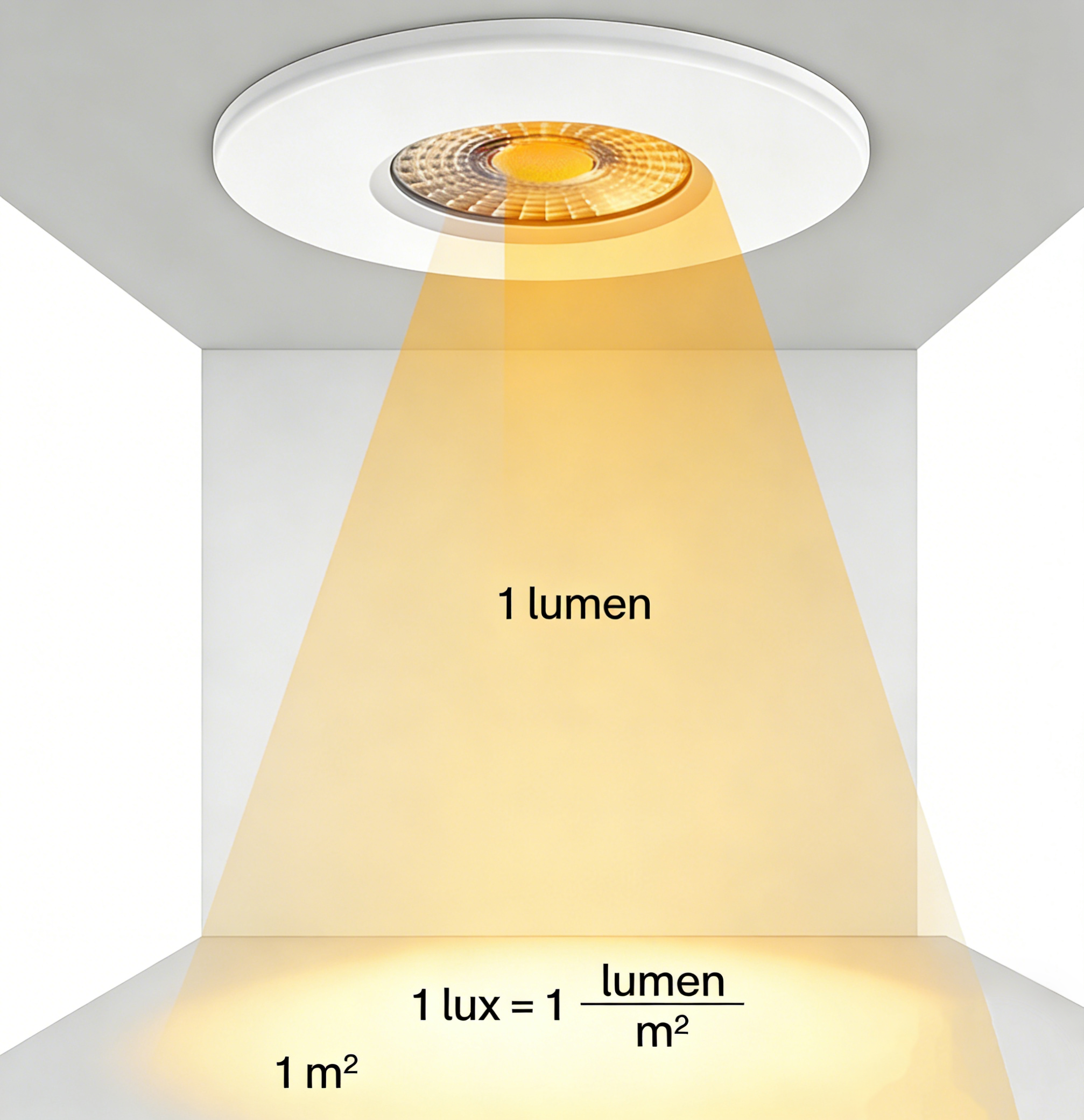
Lux (symbol: lx) is the SI unit for illuminance. Simply put, if lumens describe “how much light a source emits”, lux describes “how much light a surface receives”. The basic formula is:
1 Lux = 1 Lumen / 1㎡
So if 100 lumens spread evenly over 1 square metre, the surface illuminance is 100 lux.
To understand the LUX better, here are some typical natural light levels (actual values vary with location, season, and weather):
|
Lighting Condition |
Illuminance Range (lux) |
|
Bright summer midday sunlight |
100,000 and above |
|
Overcast daytime |
10,000–25,000 |
|
Indoor near window on an overcast day |
1,000–5,000 |
|
Winter overcast day |
Approx. 3,500 |
|
Twilight |
Approx. 750 |
|
Full moon night |
Approx. 0.25 |
|
Starlight or extremely dark environment |
Below 0.01 |
These figures show the wide range of natural light. Artificial lighting must be adjusted precisely for each space. Too little light causes eye strain. Too much brightness creates discomfort.
Why Must Lux Be Calculated in Lighting Design
The main goal of lighting design is to deliver enough light for people to perform tasks comfortably and safely. Relying only on lumens often results in “enough total light but poor distribution,” creating dark areas that reduce efficiency.
Ensuring Task Performance and Visual Comfort
Calculating lux ensures the lighting matches the actual requirements of the space, whether it’s for precision tasks or general ambiance.
Optimization through DIALux Simulation
Professional designers use software such as DIALux to simulate lux distribution. This helps achieve:
High Uniformity: Ensuring Overall Uniformity typically remains between 0.4–0.6.
Glare Control: Maintaining a Unified Glare Rating (UGR) below 19 to meet ergonomic standards and improve productivity.
Safety and Regulatory Compliance
In hospitals, factories, and public areas, insufficient illuminance is more than an aesthetic issue—it is a serious safety risk.
Adherence to International Standards
Standards such as EN 12464-1 and IES define minimum maintained illuminance levels to prevent accidents. For example:
Operating Theatres: 1,000–1,500 lux for surgical precision.
Corridors & Stairs: At least 100 lux to prevent falls.
Warehouses: Sufficient vertical illuminance for safe forklift movement and label reading.
Maintenance Factor and Depreciation
Designers must account for light depreciation (lumen drop over time) during calculations. Ignoring lux maintenance can lead to long-term safety issues or project rejection during final inspection.
Energy Efficiency and Sustainability
Accurate lux planning is a cornerstone of green lighting.
Avoiding Over-lighting: Prevents wasting electricity and reduces carbon emissions.
Optimizing Luminaire Count: Ensures the exact number of fixtures are used—neither too many (wasting capital) nor too few (requiring costly additions later).
Illuminance Requirements for Different Spaces (Reference to European Standards)
To help wholesalers and distributors select the right products, we have prepared the following recommended illuminance table for common applications:
|
Application Scenario |
Recommended Illuminance (lux) |
Purpose of Lighting |
|
High-end office / drawing room |
500 - 750 |
Improve concentration and reduce eye strain |
|
Retail store / supermarket main area |
300 - 500 |
Create a comfortable shopping atmosphere and guide flow |
|
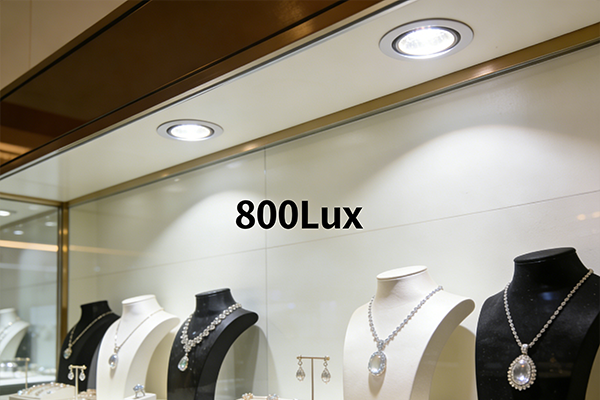
Key display areas (jewellery / fashion) |
800 - 1,500 |
Highlight product quality and attract attention |
|
Restaurant / hotel lobby |
100 - 200 |
Create a warm and intimate atmosphere |
|
Warehouse / loading platform |
150 - 200 |
Ensure safe operations and label identification |
|
Corridors / staircases |
100 - 150 |
Basic guidance and fall prevention |
|
Home kitchen / bathroom |
300 - 500 |
Ensure clear visibility for daily tasks |
Why Does the Same Luminaire Produce Different Illuminance
Even with the same lumens, actual illuminance can vary greatly due to several factors:
Mounting Height
Light follows the inverse square law. Raising the mounting height from 3 m to 6 m reduces ground illuminance to only one quarter of the original value. This is why high-ceiling factories need powerful narrow-beam high-bay lights to maintain adequate illuminance.
Beam Angle
Beam angle determines light concentration.
- Narrow beam (e.g. 24°, 36°) focuses light into a smaller area, producing higher illuminance — ideal for high mounting or accent lighting.
- Wide beam (e.g. 60°, 90°, 120°) spreads light more evenly, offering lower illuminance but better coverage — suitable for lower ceilings and general lighting.
With the same lumen output, narrow-beam luminaires can deliver several times higher illuminance than wide-beam ones, though dark spots may appear at the edges. Selection should always consider space size and IES photometric curves.
Number and Layout of Luminaires
A single luminaire provides limited illuminance. The combination of multiple luminaires and their spacing directly affects uniformity. Spacing that is too wide creates hot spots and dark areas, while spacing that is too tight wastes energy and may cause glare. Professional designs use the spacing criterion and DIALux simulation to optimise layout, ensuring the minimum illuminance meets the required standard. Wall and ceiling reflectance also plays a major role — high-reflectance surfaces can increase effective illuminance by 20%–50%.
Other factors include luminaire efficacy, dirt accumulation over time, and light incidence angle. These explain why identical luminaires can perform very differently from one project to another. Accurate simulation and on-site measurement are therefore essential.
How We Help Achieve and Maintain the Desired Illuminance — Our Commitment
Long-term illuminance depends on many real-world factors, especially lumen depreciation. This is the gradual drop in light output over time, caused by chip ageing, phosphor degradation, heat, and driver performance. Low-cost LED luminaires often suffer rapid initial depreciation due to poor heat dissipation or inferior components. Brightness can drop sharply within a few thousand hours, causing illuminance to fall below the design target. This affects comfort, safety, and energy efficiency.
Therefore, choosing a reliable supplier is critical. A-ONE Lighting Factory has 18 years of experience in LED lighting manufacturing and specialises in high-quality residential and commercial solutions. We strictly follow international standards and conduct thorough testing:
- IES LM-79 testing with integrating spheres and goniophotometers to verify luminous flux, light distribution, CRI, CCT, and electrical performance.
- Long-term ageing tests (based on LM-80/TM-21 methods) to predict realistic lumen maintenance and maintained illuminance.
- Rigorous thermal design, stable drivers, and quality materials to keep depreciation rates well below industry averages.
We provide product warranties of five years or more and offer full technical support. Choosing A-ONE means choosing reliable illuminance performance. Through precise lux calculation, optimised design, and high-quality luminaires, we help you achieve energy savings and successful lighting projects.
 How to Choose the Right Beam Angle for Your Lighting Project


 2F, Building 2, Zhongda Industrial Park, Dongshan Industrial Street, Zhangmutou Town, Dongguan, Guangdong 523619, China